
The pre-election campaign is in full swing, and the elections are next Sunday, 4 October. I open Facebook and, of course, the candidates start popping up. Soon you won’t be able to open a recipe for burek without someone promising you a better Bosnia and Herzegovina along the way.
First name. Last name.
Person with a disability. Civilian war victim. Disabled war veteran. Mother of three. Father of four.
Okay. That tells me something about the person. It tells me part of their life story. It might even tell me something about problems they understand better than someone who has never lived them.
But it still doesn’t tell me the most important thing:
Why should I vote for you?
And before anyone concludes that I have something against candidates with disabilities, let’s settle that right away. I am a person with a disability. That is exactly why I’m asking.
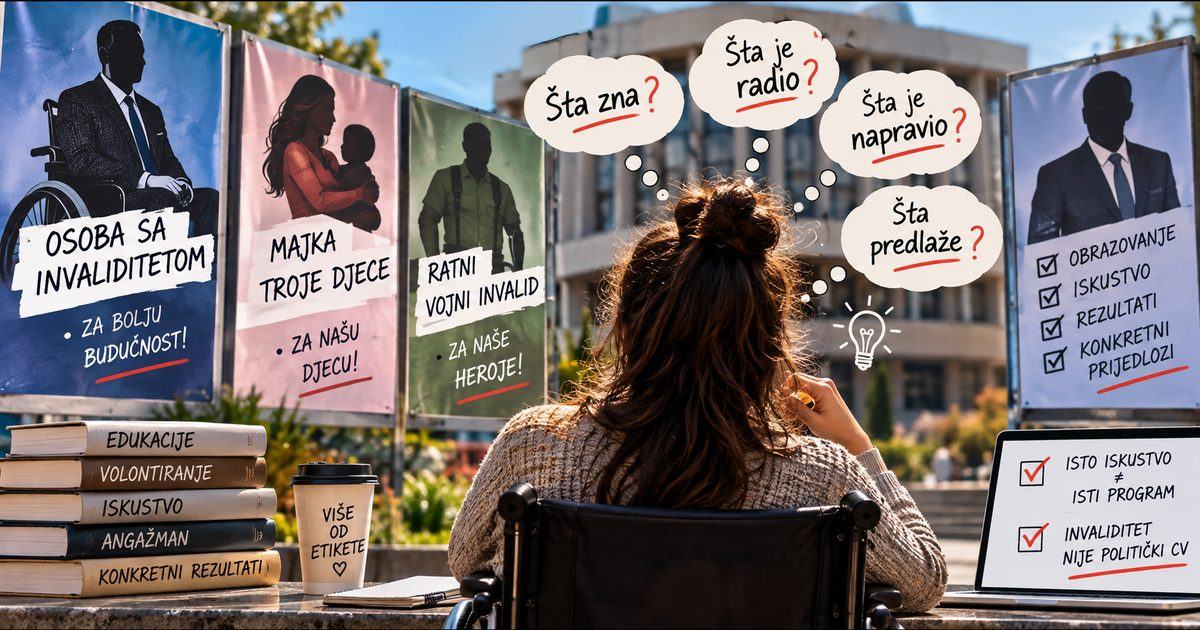
We are not a political package deal
Why would the fact that a candidate uses a wheelchair, has cerebral palsy, a visual impairment or any other disability automatically mean they will represent me?
It doesn’t. We can have the same disability and completely different values. We can use the same wheelchairs, curse the same sidewalks and have completely different ideas about how the state should work.
Shared experience is not the same as shared politics.
I won’t vote for someone just because they are a person with a disability, just as I don’t expect women to automatically vote for a woman, or parents to vote for a candidate because he wrote that he is a father of three.
Lovely. But parliament is not a parent-teacher meeting.
Disability is experience. It is not a political CV.
Let’s be clear, the experience of disability can be very valuable.
Someone who tries to get into an inaccessible institution every day probably doesn’t need a 48-page report to explain what an architectural barrier is. Someone who has spent years trying to get a decent wheelchair knows what the assistive devices system looks like far better than someone who last said the word “wheelchair” at a committee meeting.
But between “I know what the problem looks like” and “I know how to solve it through law, budget and institutions” there is quite a lot of space.
That is where my questions begin.
- What did you do before the campaign?
- How did you invest in yourself?
- Did you learn something new, take trainings, volunteer, work in the community, join initiatives, help others, gain experience that didn’t have to end with a diploma on the wall?
- What did you try to change?
- What did you turn from your own experience into something that helps other people too?
And most importantly, what exactly will you do if you get the mandate?
Then I started digging through the biographies
I admit, I went into this with a certain assumption. I thought I would very quickly find a pile of candidates with disabilities presented on the principle:
“Person with a disability. Inspiring life story. Vote.”
And this is where the research brought me back down to earth. I didn’t find enough publicly presented candidates with disabilities to honestly claim that such a general pattern exists.
Which is actually a good thing. I don’t want to write a text and then go looking for facts to confirm it. That is an excellent recipe for political propaganda, and here I’m trying to talk about exactly the opposite.
With one candidate I started looking into, there is an additional important nuance. For years before this campaign, he spoke publicly about inaccessibility, the different rights of civilian war victims and disabled war veterans, assistive devices and problems with public transport. So saying he dealt only with his own problems would not be true.
But that brings us back to the original question:
Is publicly pointing out a problem the same as a political qualification?
No. But it is something that should be taken into account.
And that is exactly why this text shouldn’t be a hunt for people, but a hunt for criteria.
And then I looked at those without disabilities
This is where things get interesting. On the website of one political organization you can find dozens of candidate biographies.
For candidates with serious professional experience, the pattern often looks perfectly normal: university, profession, work experience, positions, results, and somewhere near the end we learn that the candidate is married and a father of two, three or four.
In other biographies, family status gets much more space. One candidate is presented with her secondary education, the fact that she is a mother of two, and experience she built with a focus on family and the local community. Another is introduced straight away as the child of a fallen soldier and a mother of two sons.
And that is when a second light bulb went on. Maybe the problem isn’t:
“How do we present candidates with disabilities?”
Maybe the bigger problem is:
“What have we in BiH started presenting as a political qualification?”
Motherhood. Fatherhood. War record. Family tragedy. Disability.
These are all important parts of someone’s life. But none of them, on its own, tells you whether a person can read a budget, write an amendment, understands which level of government is responsible for what, or has any idea what they will do for four years with the mandate we gave them.
And then one example turns the story around
I also found a candidate who works on employment of persons with disabilities in his professional life and who put forward fairly concrete proposals in the campaign.
He talked about workplace accessibility, vocational rehabilitation programs and a concrete problem in the state-level institutions of BiH, where the rules on mandatory employment of persons with disabilities are not regulated the same way as at the entity level. He said that this is exactly the issue, together with the accessibility of state institutions, that he would raise if he got the mandate.
We can agree or disagree with his policies. But this is at least political information.
Problem. Responsibility. Proposal.
That is what I want to read when you present a candidate to me. I don’t need his blood type, his star sign and how many children he has before I find out what he plans to do in parliament.
And here I need to explain what “education” means to me
When I said I was interested in candidates’ education, I didn’t mean only a university degree. It would be pretty hypocritical if I did.
I had my own problems with the accessibility of the school system. I finished school as an external student. And before I got my first formal job, I volunteered for more than ten years, learned by doing, went through trainings, got involved wherever I could and collected experience that cannot be reduced to one piece of paper.
So what I want to know from a candidate is not only: Which school did you finish?
I’m much more interested in: What did you do with yourself before you were a candidate?
- Did you invest in your own knowledge?
- Did you volunteer anywhere?
- Were you involved in your community?
- Did you get additional training?
- Did you learn something that helps you understand the job you are now asking my vote for?
- Have you ever organized, led, started or finished anything?
Because formal education is valuable, but it is not the only form of education. Especially not in a country where schools, universities and educational institutions have for years been physically, communicatively or systemically out of reach for many persons with disabilities.
I can’t first build stairs in front of someone’s university and then, twenty years later, ask them why they don’t have a degree. That would be a bit much, even for our system.
But at the same time, inaccessibility doesn’t mean we should expect no investment in oneself, no experience, no engagement and no trace of previous work from a candidate. That is the difference.
A qualification is not just a piece of paper. A qualification can be knowledge, experience, continuous learning, volunteering, activism, professional work, running projects, working with people and concrete results.
So my test is not: “Where is your diploma?”
My test is:
- What do you know?
- How did you gain that knowledge?
- What have you done?
- What have you achieved so far?
- What exactly do you propose?
And maybe most importantly:
Do you understand what the office you are running for can actually change?
Because promising everything to everyone is easy. Knowing who is responsible for what is a slightly harder sport.
I don’t need “one of us”
There is one more thing that particularly bothers me. The idea that I, as a person with a disability, should feel some kind of obligation towards a candidate with a disability.
I don’t.
- If you are a good candidate, show me why.
- If you have results, show them.
- If you know how to solve the problem of personal assistance, assistive devices, accessibility, employment or education, explain to me how.
If you don’t know, the fact that you use the same wheelchair as I do won’t magically fill the gap.
And I actually think that is what equality is. Not lowering the bar for candidates with disabilities. Not raising it so high that they have to be a combination of Stephen Hawking, Nelson Mandela and a man who personally built a ramp in front of every institution in the country.
Just the same criteria. Serious ones.
So I’ll watch this campaign a little differently
Until the elections, whenever a candidate pops up, I’ll try to ignore the label written in the biggest letters and look at what is underneath it.
I’m not only interested in who you are. I’m interested in what you know, how you got that knowledge, what you have done and what you intend to do with public office.
Because “person with a disability” is not a political platform. Just as “mother of three” is not a political platform.
These are facts of life. And a mandate is a job.
And it is high time we started asking for the job description.
What do you think?
- When you look at a candidate’s biography, what matters more to you: life experience, knowledge and investment in yourself, previous results or a concrete program?
- Would you give a candidate extra trust because they belong to the same social group as you?
- And during this campaign, have you come across a candidate who offered a concrete solution to a problem, instead of the usual “we will advocate for”?
Write to me. Because campaigns are full of people who will advocate for something. I’m more interested in what they will actually do.
Note: The examples in this text are based on publicly available party biographies of candidates and media interviews from 2020 and 2026. I deliberately don’t name names or add links, because this text is not about individuals, but about the criteria we use to choose.